
Our Philosophy
— Pain Relief Is Not the Goal —
Our clinical practice is firmly grounded in modern Western sports medicine.
All evaluation, diagnosis, and clinical decision-making are based on anatomy, physiology, pathology, biomechanics, and sports medicine principles.
I received my chiropractic education in the United States and hold the DACBSP (Diplomate of the American Chiropractic Board of Sports Physicians)—a board-certified sports medicine qualification held by only a limited number of chiropractors.
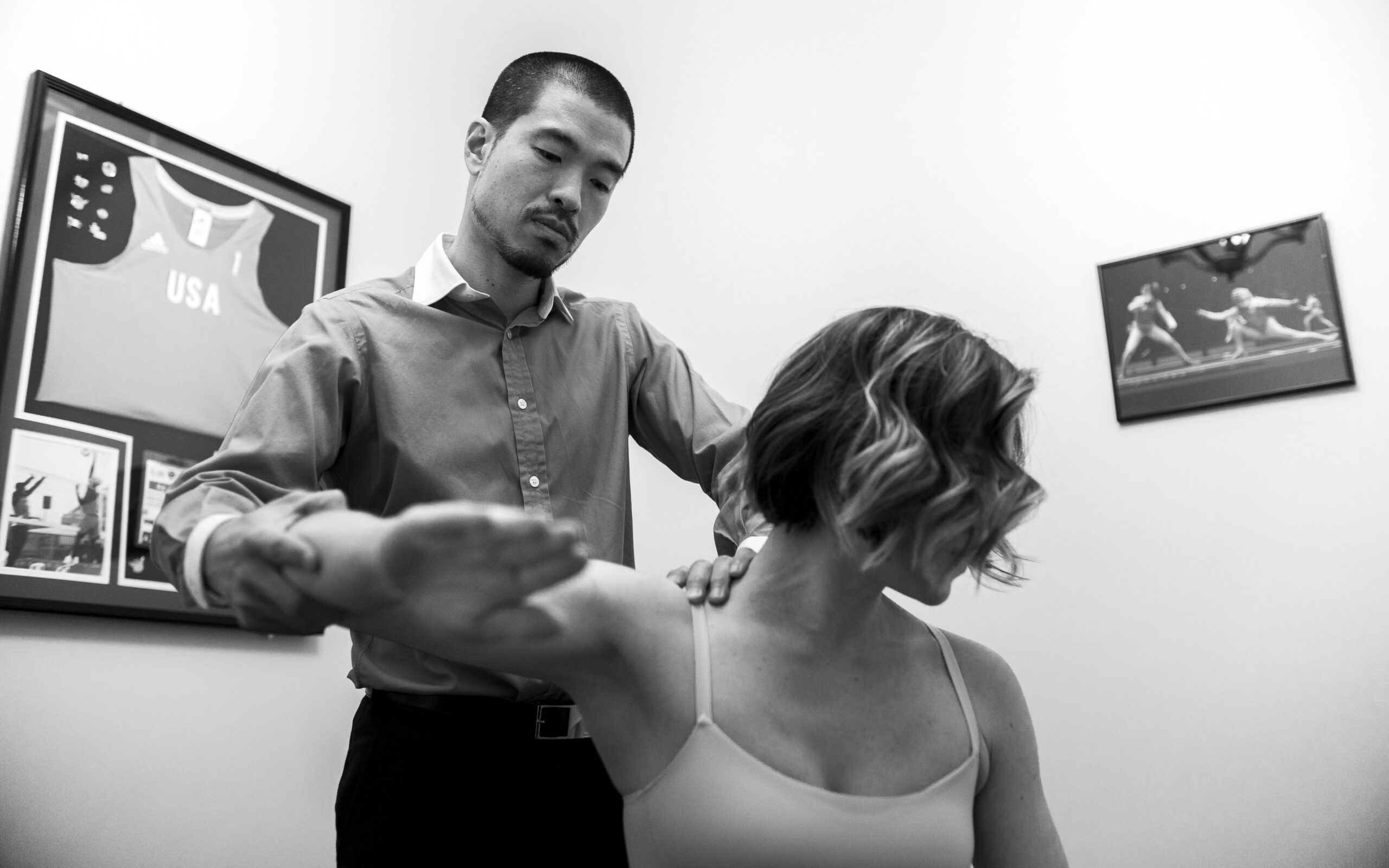
I served as medical staff as part of Team USA, traveled with TEAM USA for the Olympic Games and Pan American Games, and currently continue to treat active Olympic and elite-level athletes.
This background defines how I evaluate risk, how I interpret pain, and how I make clinical decisions.
Patients should not expect a conventional chiropractic office experience.
The Influence of Japanese Manual Therapy and Clinical Perspective
While my medical foundation is entirely Western, my clinical perspective has been shaped by Japanese manual therapy and Eastern medical philosophy.
This does not mean that I practice alternative medicine, nor does it mean rejecting modern healthcare.
Rather, it reflects an approach that emphasizes understanding the body as an integrated system, rather than a collection of isolated parts.
In Japanese clinical philosophy, there is a long-standing concept:
Do not examine only the tree—understand the forest it belongs to.
That principle continues to influence how I evaluate pain, movement, and recovery.
At the age of 18, I entered a Japanese university specializing in acupuncture and traditional medicine, where I studied Eastern medical theory in a structured, academic setting for four years.
Following this, I completed approximately four years of hands-on clinical training at our family-run clinic, Nakano Seitai, a Japanese manual therapy practice founded in 1926.
This was not observational training.
I treated patients daily, worked hands-on, and carried direct clinical responsibility alongside my father, brothers, and senior clinicians.
Only after this foundation did I move to the United States to pursue formal chiropractic education and advanced sports medicine training.
Because of this path, I do not approach Japanese manual therapy or Eastern thought as something unfamiliar, symbolic, or mystical.
I understand it deeply—and I deliberately choose how, and how much, of it belongs in modern, evidence-based clinical care.
How This Differs from Conventional Chiropractic Care
In many chiropractic practices, spinal adjustments are the primary focus of treatment.
In recent years, these are often supplemented with traction devices, decompression tables, lasers, or other passive modalities.
I am fully trained in chiropractic manipulation, commonly referred to as adjustments, and I use them when clinically appropriate.
However, they are not the centerpiece of my care.
The reason is simple:
Manipulation alone does not improve long-term functional movement capacity.
Moreover, most athletic injuries and musculoskeletal conditions originate from soft tissue dysfunction, not from the spine itself.
Even when performed perfectly, spinal manipulations do not:
- Change how a person moves
- Treat soft tissue injuries such as tendon or muscle pathology
- Improve overall movement quality
- Address why pain continues to return
And most importantly, these techniques are widely available.
They are not where the true clinical challenge lies.
The Real Challenge: Understanding What Is Actually Happening
Explaining pain as “poor posture,” “misalignment,” or “imbalance” is relatively easy.
These concepts can be useful clinical descriptors and are commonly referenced in chiropractic care in the United States.
What is far more difficult—and far more important—is understanding why a problem developed in the first place.
That requires answering deeper questions such as:
- Why did mechanical load accumulate in a specific tissue?
- Why did movement patterns change over time?
- Why did recovery capacity decline?
- Why can the body no longer tolerate normal daily stress?
Imaging studies such as X-rays or MRI can be valuable tools, and I use them when clinically appropriate.
In a small percentage of cases, surgical, interventional, or pharmacologic care is necessary, and referrals are made without hesitation when indicated.
When needed, I collaborate with orthopedists or pain management physicians as part of responsible, patient-centered care.
However, in many musculoskeletal conditions, a diagnosis alone does not explain why the problem developed.
The most meaningful clinical work happens at the level of functional movement:
- How you stand, walk, and move
- How past injuries shaped compensation patterns
- How lifestyle, training history, and aging interact
- How stress, sleep, and recovery affect the nervous system
Evaluating the body as a single functional system requires time, experience, and clinical judgment.
This level of assessment cannot be automated, outsourced, or reduced to standardized protocols.
In many cases, the ICD-10 diagnosis—the medical label—is not the root cause, but rather the result of an underlying loss of functional movement capacity.
The Role of Manual Therapy in Our Practice
In our clinic, manual therapy is not simply a tool to eliminate pain.
It is a clinical process used to:
- Safely modulate pain
- Assess how much movement is currently available
- Distinguish what is safe versus what carries risk
- Prepare the body for active rehabilitation and training
In Olympic and elite sports settings, manual therapy plays a central role—not because it is passive, but because it allows us to determine quickly and accurately whether an athlete is truly ready to move.
The goal is never short-term relief alone.
The goal is to restore safe, usable movement.
To an outside observer, manual therapy may look the same everywhere—hands on the body, similar positions, similar techniques.
In reality, the clinical process behind it is entirely different.
Effective manual therapy requires:
- A precise understanding of anatomy, physiology, and pathology
- The ability to assess tissue quality, density, and resistance
- Identification of restrictions that limit movement or load tolerance
- Application of therapeutic force with clear intent and purpose
- Continuous reassessment of range of motion, tissue response, and safety
Manual therapy is not about “doing something to the body.”
It is about reading the tissue, guiding it, and observing how the body responds under controlled conditions.
This is why manual therapy allows me to work at the highest levels of sport—not because the technique itself is special, but because the clinical judgment behind it is.
In our practice, manual therapy—not spinal adjustment—is central to the treatment process.
From an anatomical and clinical perspective, the majority of musculoskeletal symptoms originate in soft tissue, and these structures require the greatest attention when treating the human body.
Manual therapy serves as the link between diagnosis and movement—bridging that gap and allowing us to safely introduce clients to active care.
A Consistent Clinical Goal
After years of clinical practice, my conclusion is simple:
Most musculoskeletal pain is the result of decreased functional movement capacity.
Therefore, our goal is not:
- Quick pain relief
- Routine spinal adjustments
- Symptom suppression
Our goal is to restore and maintain functional movement, so that people can continue to move independently throughout their lives.
To do this, we evaluate the entire system:
- From toes to head
- Posture, gait, and movement patterns
- Training history and daily habits
- Recovery capacity and age-related change
We work within modern medical standards, collaborate when necessary, and avoid unnecessary interventions.
At the same time, we prioritize hands-on clinical judgment and long-term functional outcomes over temporary fixes.
This is not Eastern medicine.
This is not alternative care.
It is Western sports medicine, informed by a broader understanding of how the human body adapts, compensates, and recovers over time.
That philosophy guides every decision we make in our clinic.